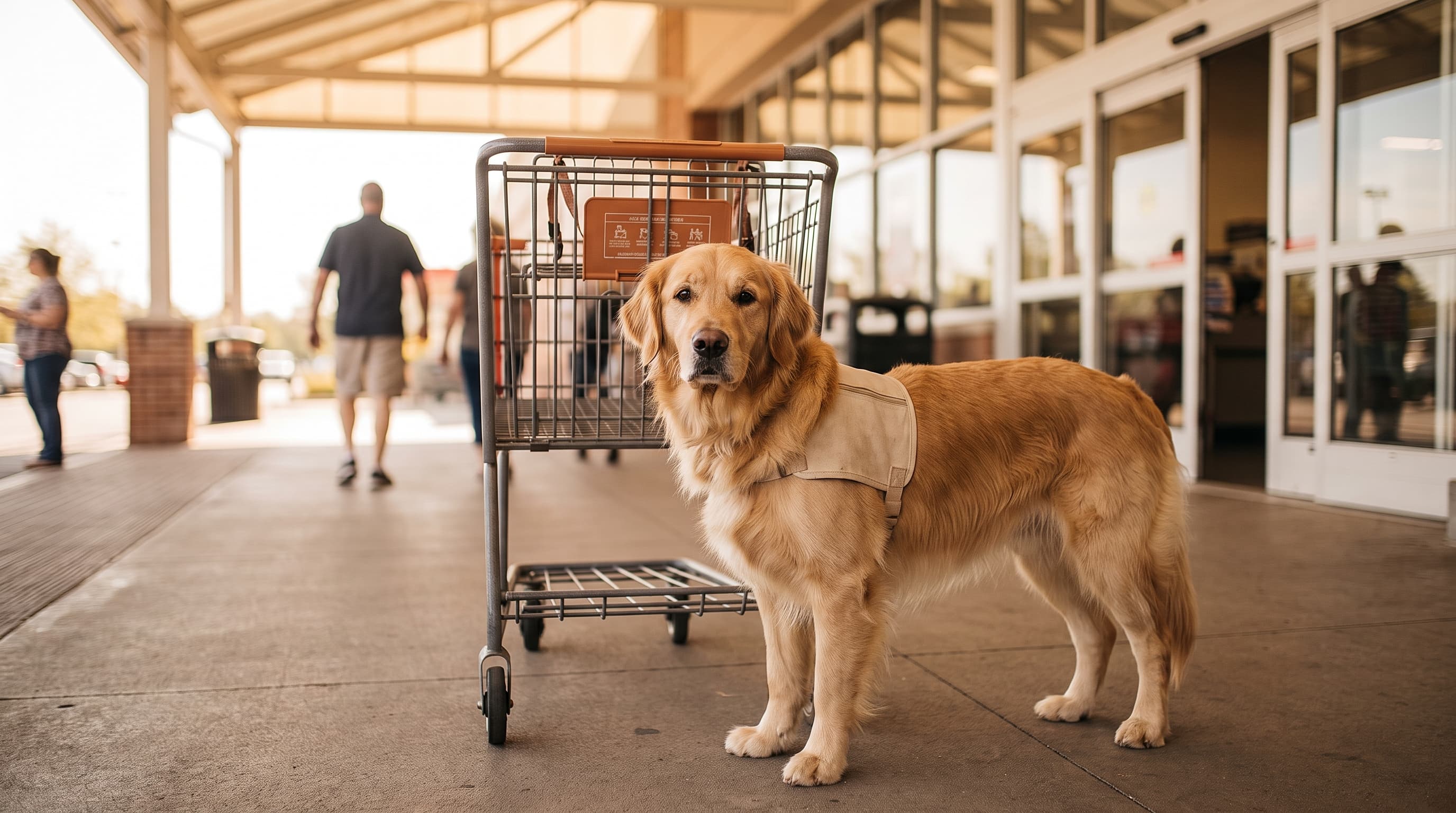

Are Dogs Allowed in Walmart? The Full Pet Policy Explained (2026)
No, Walmart does not allow pet dogs inside its stores. Only trained service animals protected under the Americans with Disabilities Act (ADA) are permitted. Pets, emotional support animals, and therapy dogs are officially prohibited. In practice, enforcement is inconsistent and varies widely from one store and manager to the next.
If you have ever seen a dog riding in a Walmart shopping cart and wondered whether the rules changed, you are not alone. Walmart is one of the most searched retailers when it comes to pet policies, largely because what the corporate policy says and what actually happens on the sales floor are often two different things. Below, we break down exactly what the official rules are, what the law requires, and how to shop with your dog the smart way in 2026.
Walmart's Official Pet Policy in 2026
Walmart's policy is straightforward on paper: the company welcomes service animals as defined by the ADA, and it does not permit pets inside its stores. This mirrors the standard adopted by the vast majority of grocery and general-merchandise retailers in the United States, and it is driven in large part by food-safety regulations. Because most Walmart Supercenters sell groceries, fresh produce, and prepared foods, health codes in nearly every state prohibit non-service animals in areas where food is sold or handled.
Walmart does not publish a splashy standalone "pet policy" page, but its position is consistent with federal disability law and its broader corporate policies. The short version: if your dog is a working service animal, it is welcome. If your dog is a pet, a puppy you are socializing, an emotional support animal, or a therapy dog, it is not permitted under the official rules, even though you may occasionally see all of the above inside a store.
It is worth noting that this is a nationwide corporate stance, not a local one. Individual stores cannot create a more permissive "dogs welcome" policy, and they also cannot lawfully turn away legitimate service animals. Everything in between is where the real-world confusion lives.
Service Animals and the ADA Two-Question Rule
Under the ADA, a service animal is a dog that has been individually trained to do work or perform tasks for a person with a disability. Examples include guiding people who are blind, alerting people who are deaf, pulling a wheelchair, alerting to and protecting a person having a seizure, reminding a person to take medication, or calming a person with PTSD during an anxiety attack. The key requirement is training to perform a specific task tied to a disability, according to the U.S. Department of Justice's 2010 ADA service animal requirements.
When it is not obvious what service a dog provides, Walmart staff are legally limited to asking only two questions, as spelled out in the DOJ's service animal FAQ:
- Question 1: Is the dog a service animal required because of a disability?
- Question 2: What work or task has the dog been trained to perform?
That is the entire list. Staff cannot ask about the nature or extent of your disability, cannot require the dog to demonstrate its task, and cannot demand documentation, a certificate, an ID card, a vest, or registration of any kind. The ADA explicitly states that businesses may not require proof that an animal has been certified, trained, or licensed as a condition of entry, and it notes that online "certification" documents convey no rights whatsoever. The same standard is echoed by the ADA National Network, which confirms that service animals are allowed in all public areas of a business where customers are normally allowed.
There are a few narrow limits. A service animal must be housebroken and under the handler's control, typically on a leash or harness unless a disability prevents it. A business may ask that a specific service animal be removed if it is out of control and the handler does not take action, or if it is not housebroken, per the DOJ's service animals overview. Even then, the business must still offer the person the chance to shop without the animal present.
Why Enforcement Varies From Store to Store
Here is the reason you have almost certainly seen a small dog peeking out of a cart at Walmart: enforcement is left largely to individual store managers and associates, and most of them are reluctant to confront customers. There are several practical reasons for this inconsistency.
First, associates are trained to avoid conflict. Challenging a customer about a dog risks a scene, a viral video, or an accusation of discriminating against someone with a hidden disability. Second, because the ADA forbids asking for documentation, staff genuinely cannot tell a "fake" service dog from a real one just by looking. A calm, leashed dog wearing a vest bought online is legally indistinguishable at a glance from a trained service animal. Third, priorities differ by location. A busy urban Supercenter may have zero appetite for policing pets, while a store that has had sanitation complaints may enforce the rule strictly.
The result is a patchwork. In some stores, no one will say a word if you bring a leashed dog inside. In others, a greeter or manager will politely ask the two ADA questions and turn you away if your answer makes clear the dog is a pet. Neither outcome changes the official policy, which still prohibits pets. If you are counting on a friendly store, understand that you are relying on lax enforcement, not permission, and that the next visit or the next manager could go differently.
Are Emotional Support Animals (ESAs) Allowed at Walmart?
No. This is one of the most misunderstood points in all of retail. Emotional support animals and therapy dogs are not service animals under the ADA, and they do not have public-access rights. The DOJ is explicit: a dog whose sole function is to provide comfort or emotional support does not qualify as a service animal, because comfort is not a trained task. That means an ESA has the same standing as any other pet inside a Walmart, and Walmart is under no obligation to admit one.
The confusion usually comes from other laws. Emotional support animals do have certain protections under the Fair Housing Act when it comes to where you live, and historically had some rights on aircraft, but those laws do not extend to stores, restaurants, or other places of public accommodation. An ESA letter from a doctor or therapist is meaningful for housing, but it grants no right to bring the animal into Walmart.
One important nuance: a psychiatric service dog is different from an ESA. If a dog is trained to perform a specific task, such as interrupting a panic attack, providing deep pressure therapy, or retrieving medication, it qualifies as a service animal even though the disability is psychiatric. The distinction is always the same: trained task versus mere presence.
What Happens If You Bring Your Dog Anyway?
If you walk a pet into a Walmart, one of a few things will happen. Most commonly, nothing. You will shop, check out, and leave without anyone commenting. That is not the same as approval; it just means enforcement was lax that day.
Alternatively, an associate, greeter, or manager may approach you and ask the two ADA questions. If you honestly indicate the dog is a pet or an emotional support animal, you can be asked to take the dog back to your vehicle and shop without it. Refusing can escalate to a manager and, in rare cases, a request to leave the store for trespassing. You will not be "arrested" for having a dog, but you can be lawfully asked to leave a private business.
A word of caution that matters more than the policy itself: never leave a dog in a parked car to shop, especially in warm months. Interior car temperatures climb dangerously fast even on mild days, and many states have laws that allow authorities, and sometimes bystanders, to intervene. If bringing your dog means leaving it in the car, leave the dog at home instead.
Finally, please do not misrepresent a pet as a service animal. Beyond being dishonest, many states have passed laws making service-animal fraud a punishable offense, and it undermines access for people who genuinely depend on trained service dogs.
Pet-Friendly Stores to Shop Instead
If your goal is to run errands with your dog in tow, plenty of major chains genuinely welcome leashed, well-behaved pets. These are usually stores that do not sell fresh food, which sidesteps the health-code issue that keeps dogs out of Walmart's grocery aisles.
- Home improvement stores like Lowe's and The Home Depot are famously dog-friendly.
- Pet retailers such as Petco and PetSmart obviously welcome pets, and often host adoption and vaccine events.
- Hardware and farm-supply stores like Tractor Supply Co. actively encourage customers to bring dogs. See our full guide on whether dogs are allowed in Tractor Supply.
- Bookstores, craft stores, and many clothing retailers tend to be flexible. For fashion and home goods, check our breakdown of whether dogs are allowed at TJ Maxx.
Warehouse clubs, on the other hand, follow rules very similar to Walmart's because they also sell food. If you are comparing membership retailers, read our guides on whether dogs are allowed in Costco and whether dogs are allowed in Sam's Club before you plan a trip with your pup.
Walmart Pickup and Delivery Workarounds
The easiest way to "shop Walmart with your dog" is to never bring your dog inside at all. Walmart's digital fulfillment options have expanded dramatically and let you avoid the pet-policy problem entirely.
- Curbside pickup: Order online or in the app, drive to the store, park in a designated pickup spot, and an associate loads your groceries into your car. Your dog can ride along in the vehicle the entire time, and you never step inside.
- Home delivery: Walmart delivers groceries and general merchandise to your door, often same-day. Your dog stays comfortable at home.
- Walmart+ membership: For frequent shoppers, the paid membership bundles free delivery, fuel discounts, and other perks that make skipping the in-store trip even easier.
These options are ideal for anyone who cannot leave a dog home alone, is training a young puppy, or simply does not want to gamble on whether a particular store will enforce its pet rules that day.
Tips If You Must Bring Your Dog
If you have a legitimate service animal, or you are in a situation where bringing your dog is unavoidable, keep these practical tips in mind.
- Keep the dog leashed and under control. Even service animals must be housebroken and controlled; an out-of-control dog can be asked to leave.
- Know the two questions. If you have a service animal, be ready to state that it is required for a disability and name the task it performs. You never have to show paperwork.
- Do not put a pet in the cart seat where food and children go. It is unsanitary and draws exactly the attention you are trying to avoid.
- Call ahead if unsure. A quick call to your local store can tell you how strictly that location handles pets.
- Have a backup plan. Be prepared to use curbside pickup or return the dog to your car (never in the heat) if you are asked to shop without it.
Frequently Asked Questions
Can I bring my dog into Walmart?
No, not if it is a pet. Walmart's official policy permits only trained service animals as defined by the ADA. Pets are prohibited, though enforcement varies and some stores look the other way. Bringing a pet is not guaranteed and can result in being asked to leave.
Are service dogs allowed in Walmart?
Yes. Service dogs individually trained to perform a task for a person with a disability are welcome in all Walmart stores, including grocery areas, under the ADA. Staff may ask only whether the dog is a required service animal and what task it is trained to perform.
Does Walmart allow emotional support animals?
No. Emotional support animals and therapy dogs are not considered service animals under the ADA because comfort alone is not a trained task. They have no public-access rights at Walmart and are treated the same as any other pet, regardless of an ESA letter.
Can Walmart staff ask for proof that my dog is a service animal?
No. The ADA prohibits businesses from requiring documentation, certification, ID cards, registration, or a vest. Staff may only ask the two permitted questions and may not demand that the dog demonstrate its task or disclose details about your disability.
Will I get kicked out of Walmart for bringing my dog?
Possibly. If staff determine your dog is a pet rather than a service animal, they can ask you to take it back to your vehicle and shop without it. Refusing can escalate to a request to leave the store, but you will not be criminally charged simply for bringing a dog.
Are dogs allowed in the Walmart garden center or grocery section?
Only service animals. The same policy applies store-wide, including the outdoor garden center and the grocery aisles. Because groceries involve food safety rules, the grocery section is often where the no-pets policy is enforced most strictly.
The Bottom Line
Walmart does not allow pet dogs. Trained ADA service animals are always welcome, emotional support animals are not, and everything you may have seen to the contrary comes down to uneven enforcement rather than a change in policy. If you want to shop with your dog by your side, choose a genuinely pet-friendly retailer, and if you simply need your Walmart order, curbside pickup and delivery let you skip the dilemma entirely.
Find pet-friendly places near you and plan your next outing with confidence, dog included.